Azure OpenAI and Responsible AI Enablement
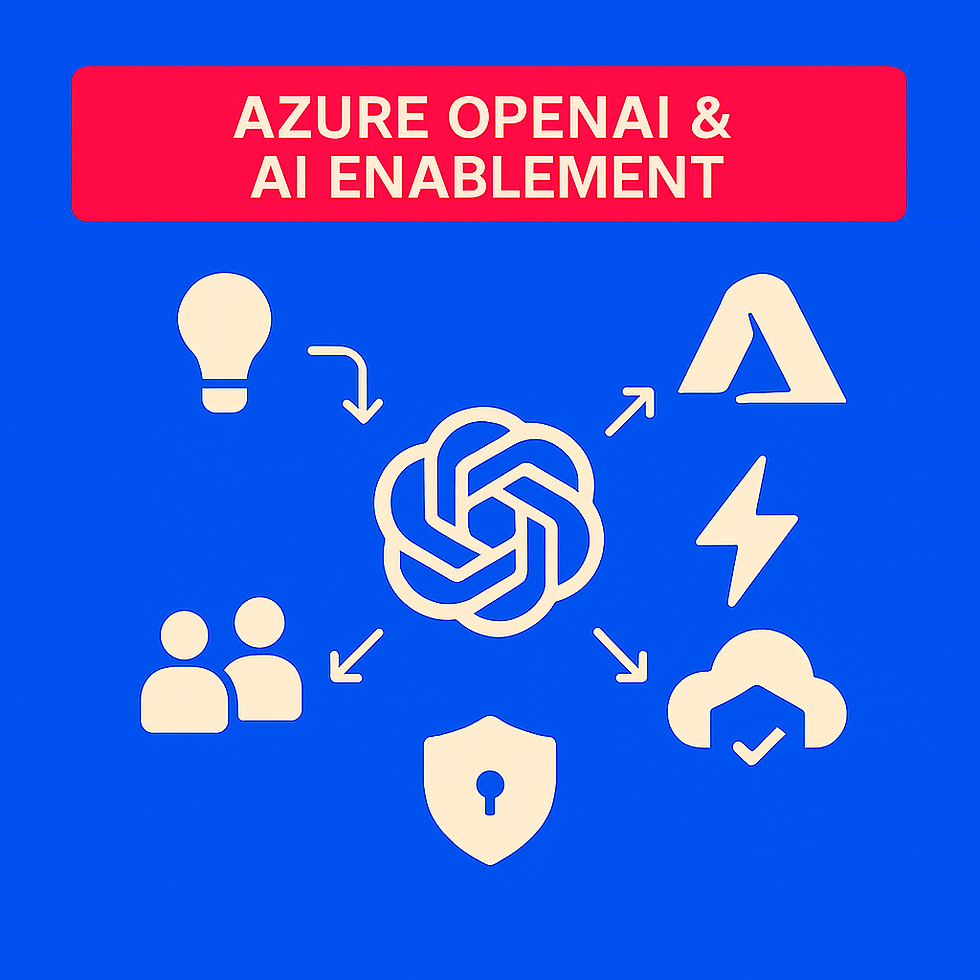
Turning Curiosity Into Capability, Safely
Interest in AI inside organizations is no longer optional.
Executives ask about it. Teams experiment with it. Vendors promote it everywhere.
Yet most organizations feel the same tension. They want to explore AI, but they are unsure where to start, what to trust, and how to stay in control.
At Cognigate, we help organizations approach Azure OpenAI and AI enablement in a way that is responsible, secure, and grounded in real business use. Not experimentation for its own sake. Not isolated pilots that never scale.
This article explains how we support organizations exploring AI through clear use cases, secure architecture, connected workflows, and strong governance.
Cognigate Point of View on Azure OpenAI and AI Enablement
AI does not fail because models are weak.
It fails because expectations are unclear and controls are missing.
Many AI initiatives start with tools instead of problems. A chatbot is built without knowing who owns it. A model is tested without clear data boundaries. Results look promising, but trust is fragile.
Our point of view is simple:
AI should be introduced as a capability, not as a feature.
That means designing how AI fits into the organization before scaling it.
Use-Case Discovery Workshops
Starting With the Right Questions
Responsible AI starts with clarity, not technology.
Before architecture or tools, we run use-case discovery workshops focused on:
Real business pain points
Decision-heavy processes
Repetitive or manual work
Areas where insight quality matters
The goal is not to generate a long list of ideas. It is to identify a small number of use cases that are valuable, feasible, and appropriate for AI.
Filtering Curiosity From Value
Not every process benefits from AI.
We help teams:
Separate curiosity from need
Understand where AI adds value versus complexity
Set realistic expectations
This avoids investing time in use cases that cannot be governed or scaled.
Azure OpenAI Architecture and Security Alignment
Designing AI Within Enterprise Boundaries
Azure OpenAI provides a controlled way to consume advanced AI models. That control only works if the surrounding architecture is designed properly.
Architecture With Security in Mind
We design Azure OpenAI architecture that aligns with:
Existing Azure tenant and subscription structure
Identity and access models
Network security and isolation
Logging and monitoring standards
AI services should follow the same security principles as other enterprise systems.
Avoiding Shadow AI
Without proper architecture, teams often experiment outside approved environments.
This creates risk around:
Data exposure
Unapproved access
Lack of auditability
A clear Azure OpenAI architecture allows experimentation without losing control.
AI Workflows Connected to Business Systems
Moving Beyond Standalone Experiments
AI delivers value when it supports real workflows.
Standalone demos rarely survive. Connected workflows do.
Designing AI as Part of the Process
We help organizations connect AI capabilities to:
CRM systems
ITSM platforms
ERP workflows
Internal applications
This allows AI to:
Assist decisions
Generate insights
Support service interactions
Reduce manual effort
AI becomes part of how work flows, not an isolated tool used occasionally.
Human-in-the-Loop by Design
We design AI workflows that include:
Review steps
Approval points
Clear escalation paths
This preserves accountability and trust, especially in regulated or sensitive environments.
Governance, Data Boundaries, and Access Controls
Making AI Trustworthy at Scale
Governance is the difference between experimentation and enablement.
Without governance:
Data boundaries blur
Access expands unintentionally
Responsibility becomes unclear
Designing AI Governance Early
We help organizations define:
Which data can be used by AI
Which data must be excluded
Who can access AI capabilities
Who approves changes and new use cases
These decisions are made before scaling, not after issues arise.
Data Boundaries That Matter
Responsible AI depends on clear data boundaries.
We design controls that:
Prevent unintended data exposure
Respect regulatory and privacy requirements
Align with internal data classification
This builds confidence across security, legal, and leadership teams.
Azure OpenAI as an Enablement Layer
When Azure OpenAI and AI enablement are designed well:
AI supports real business outcomes
Security and compliance teams remain confident
Access is controlled and auditable
Teams trust the results
AI becomes a capability the organization can grow into, not a risk it has to manage around.
At Cognigate, we help organizations explore AI responsibly, so curiosity turns into controlled, meaningful progress.



Comments