Data, Analytics, and Integration on AWS
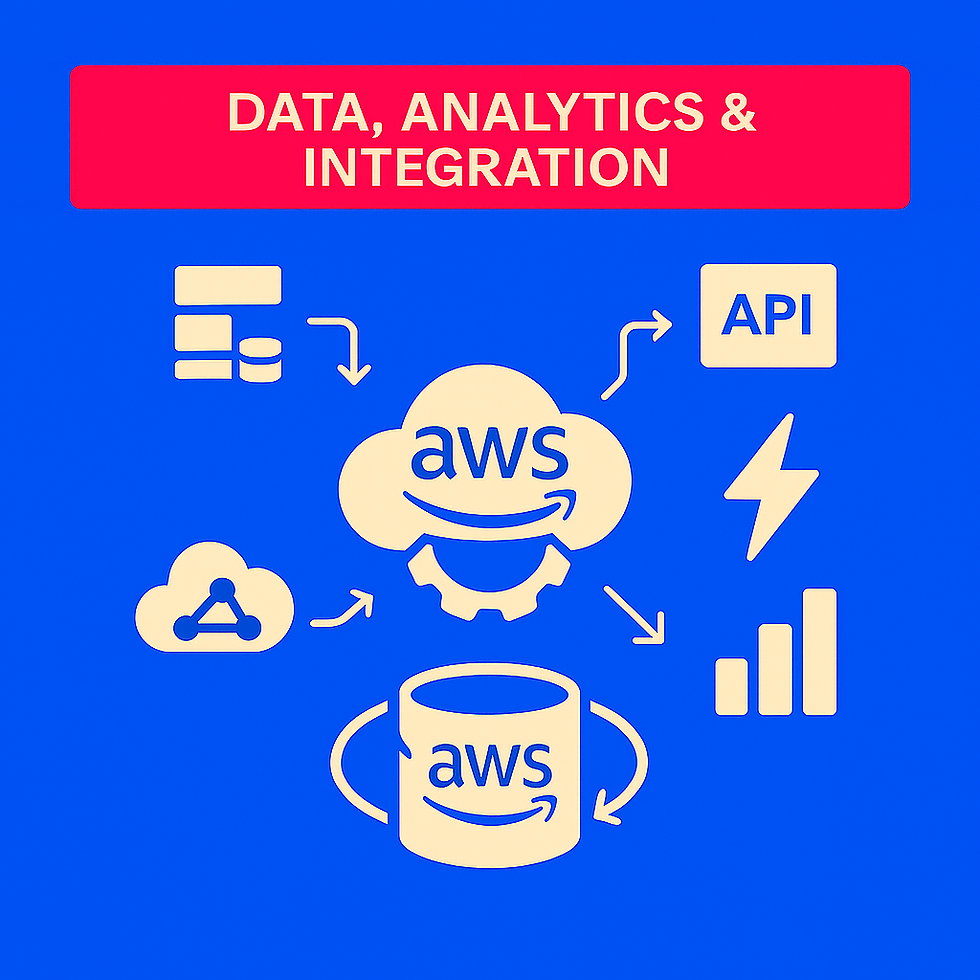
Designing Cloud Platforms That Work as One System
AWS is rarely the destination.
It is usually one part of a much larger ecosystem.
Most organizations already run a mix of CRM, ITSM, ERP, data platforms, and SaaS tools. When AWS is introduced without considering this wider context, it quickly becomes isolated. Data lives in silos. Integrations are built in a hurry. Reporting becomes fragmented. Teams spend more time reconciling information than using it.
At Cognigate, we focus on data, analytics, and integration on AWS as a connected capability. The goal is not to build pipelines for their own sake. The goal is to help AWS work as part of a bigger system that supports decisions, operations, and growth.
This article explains how we approach data, analytics, and integration on AWS, and why ecosystem thinking matters.
Cognigate Point of View on Data and Integration on AWS
Data problems are rarely technical first.
They are structural.
When systems are connected without a clear data model, reporting becomes unreliable. When integrations are built point to point without ownership, they become fragile. When analytics is treated as a dashboard project, it loses relevance.
Our point of view is simple:
AWS data and integration design should serve the ecosystem, not individual tools.
That means thinking beyond services and focusing on flow, ownership, and purpose.
Data Pipelines and Storage Design
Moving Data With Intent
Data pipelines are often built reactively. A report is needed. An integration is requested. A workaround becomes permanent.
Over time, this leads to pipelines that are hard to trace and even harder to trust.
How We Approach Data Pipelines
We design data pipelines by answering a few basic questions first:
What data is needed
Where it originates
How often it should move
Who owns it
Who relies on it
Only then do we decide how the pipeline should be implemented.
This avoids common issues such as:
Duplicate data movement
Unclear transformation logic
Pipelines that break silently
Storage that grows without purpose
Storage Design That Reflects Use
Not all data needs the same treatment.
We design AWS storage with clear intent:
Operational data
Analytical data
Historical and archival data
Each category has different access patterns, retention needs, and cost considerations. Treating them the same creates confusion and waste.
Good storage design makes data easier to find, trust, and use.
Integration With CRM, ITSM, ERP, and SaaS Platforms
Connecting the Real Systems of Record
AWS rarely owns the primary business data.
CRM systems own customer data.
ERP systems own financial and operational records.
ITSM platforms manage service workflows.
SaaS tools handle specialized processes.
Our role is to help AWS integrate with these systems cleanly and predictably.
Integration as a First-Class Design Concern
We treat integrations as part of the architecture, not as add-ons.
This means:
Clear definition of system ownership
Explicit data contracts between platforms
Controlled synchronization rules
Clear error handling and monitoring
This approach reduces the risk of data inconsistency and operational surprises.
Avoiding Integration Sprawl
Without structure, integrations multiply quickly.
We often see:
Multiple tools integrating the same data
Logic duplicated across systems
No clear source of truth
We address this by designing integration patterns that scale, rather than reacting to each new request individually.
API-Based Connectivity
Designing for Change, Not Just Today
APIs are the backbone of modern ecosystems.
They allow systems to evolve independently while staying connected.
Why API Design Matters
Poorly designed APIs create tight coupling.
Well designed APIs create flexibility.
We focus on:
Clear API purpose
Stable contracts
Versioning strategies
Security and access control
This allows teams to build on AWS without constantly breaking downstream systems.
APIs as Products
We encourage organizations to treat key APIs as internal products.
This means:
Documentation
Ownership
Usage visibility
Change management
When APIs are treated this way, integrations become easier to maintain and safer to extend.
Reporting and Analytics Foundations
From Data Movement to Decision Support
Analytics should help people make decisions, not just display numbers.
Too many reporting setups focus on tools rather than questions. Dashboards look impressive but fail to answer what teams actually need to know.
Building Analytics on Solid Foundations
We design analytics foundations on AWS around:
Clear data models
Defined metrics and definitions
Alignment with business processes
Consistent refresh and validation cycles
This ensures that reports mean the same thing across teams.
Avoiding Dashboard Fatigue
When every team builds its own dashboards, trust erodes.
We help organizations:
Agree on shared metrics
Separate operational reporting from strategic reporting
Reduce duplication
Improve confidence in insights
Analytics works best when it supports conversations, not debates about numbers.
AWS as Part of a Bigger Ecosystem
When data, analytics, and integration are designed with the ecosystem in mind:
Systems stay loosely coupled
Data flows are easier to explain
Reporting becomes more reliable
Teams spend less time reconciling and more time acting
AWS becomes a strong contributor, not an isolated platform.
At Cognigate, we design AWS data and integration architectures that fit into real enterprise environments, where multiple platforms coexist and evolve together.



Comments